I think about a meme I once saw all the time. It said “explaining patriarchy to a man is like explaining to someone who has never heard of a skeleton that there are bones inside your body.” Well, that sentiment applies to a great many things, including explaining that capitalism is a failed experiment to most anyone on our earth today.
Yes, this novel is set between two worlds, one a capitalist society, and one an anarcho-communist. But to reduce this story to that is doing it a great disservice.
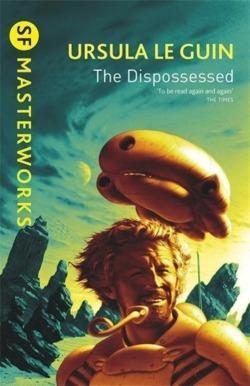
170 years after a group of anarchist revolutionaries leave their planet to settle on the moon, a man from this isolated society is invited as a guest back to the home planet.
Le Guin masterfully conveys that poignant, profound feeling of excitement, homesickness, exhaustion, and self-discovery that comes with traveling. Evokes the universal experience of going to a foreign place and committing thousands of tiny faux pas. What a brilliant way to do your world building. It manages to convey the differences in the two societies, while also characterizing Shevek, our protagonist, as he reacts to each new, perplexing interaction with his earthly hosts.
The order in which this story is told, the way she reveals information about the protagonist as the narrative bounces back and forth through time, is nothing short of genius. And for a story about a physicist whose field of study is time, how wonderfully fitting.
Every now and then, a sentence in this book made me stop reading and just look at it, blown away by the emotional impact a few words in a certain order could have on me.
One theme I love is when she points out that an explorer is only an explorer when they return home to share what they have learned.
Does the definition of a trip between planets change based on whether it is a one-way “emigration” of sorts, or if it is meant to be a trip back home at the end? Which one is self-serving egoism and which is for the good of society?
This is my second Le Guin book, and it exudes that same melancholy feeling of standing on the brink of understanding, but never getting there. It’s just like life. I will never understand everything. There will always be more mysteries. There will always be pain and sadness that accompany all the beauty and joy of existence. Her stories are achingly beautiful and they haunt me long after I have finished reading them.
When the protagonist saw the moon, his home, rise in the sky from the earth, the sentence “The light of his world filled his empty hands” made me cry.
And that’s not even touching on the other themes such as feminism, anarchy, science and the pursuit of knowledge, solidarity, and the fact that our protagonist seems to be neurodivergent enough to never fit in to any of the societies he’s lived in.
I am so glad Le Guin gave us this book.